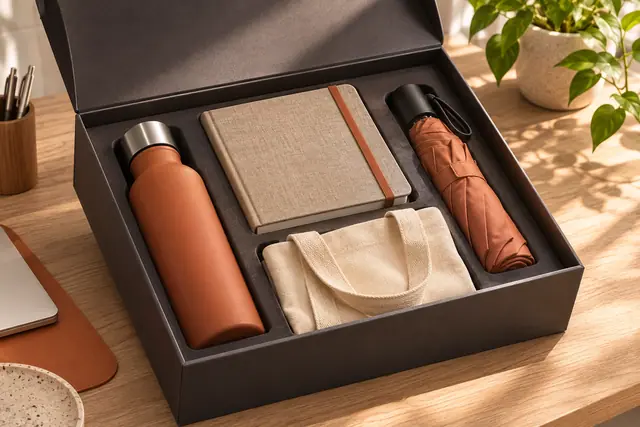
Building a Corporate Gift Set Program: Brief to Delivered Kits
A step-by-step guide to corporate gift kits: writing the brief, selecting items, choosing branding methods, designing inserts, approving samples and kitting.









Sourcing Strategy

For most importers, Christmas stock should be ordered from China between January and April, and Halloween stock between December and March, so goods can ship in early to mid summer and land well before the selling season. The exact dates depend on when the goods must be in your warehouse, how much customization is involved and your shipping route. The safest method is to start from your shelf date and count backwards through each stage.
Seasonal products have a hard deadline. A Halloween animatronic that arrives in November or a Christmas tree that lands in mid-December may have to be heavily discounted or held for a year. Planning backwards from the date stock must be available forces you to account for every stage, and shows you the latest possible date for each decision.
Start with two dates:
The durations below are typical ranges for seasonal decor, drinkware and gift items. They vary by product complexity, factory capacity and season, so confirm them with your supplier for each item.
| Stage | Typical duration | What can delay it |
|---|---|---|
| Design brief and quotation | 1 to 3 weeks | Unclear specs, late artwork |
| Sampling | 1 to 3 weeks per round | New molds, multiple revision rounds |
| Packaging artwork and approval | 1 to 2 weeks | Barcode, warning label and retailer requirements |
| Mass production | 3 to 6 weeks | Peak-season capacity, holidays, material shortages |
| Pre-shipment inspection and rework | A few days to 1 week | Failed inspection requiring rework |
| Booking, trucking and port | 1 to 2 weeks | Space shortages in peak season |
| Ocean freight | Roughly 2 to 6 weeks depending on route | Transshipment, congestion, weather |
| Customs clearance and delivery | A few days to 2 weeks | Missing documents, inspections |
For catalog items with an added logo, Home Gift Factory listings typically show sample times of 7 to 15 days and delivery of 15 to 30 days. New designs, electrical items and large seasonal orders often take longer, so build your plan on the specific quote you receive.
Here is an example backwards plan for a retailer that wants Christmas decorations, such as artificial trees, garlands and stockings, in its warehouse by early September:
Many buyers start Christmas development even earlier, reviewing new styles at trade fairs or with suppliers in the autumn of the previous year. If you are choosing between tree constructions, our PVC vs PE tree guide covers the decisions that should be locked in at the sampling stage.
Halloween merchandise usually appears in stores from late summer, so goods need to land earlier than Christmas stock. For a warehouse-ready date in early August, an example plan would be:
Animatronic Halloween decorations with motors, sound modules and batteries need extra time for function testing and, depending on the market, electrical and battery compliance. Simple items such as plastic pumpkins or skeleton props move faster.
The fastest seasonal programs start with a complete request, because every missing detail adds a round of emails and can push sampling back by a week or more. Before you send an inquiry, gather:
Sharing this information early also lets suppliers flag items that need longer lead times, such as new molds or custom lighting, while there is still time to adjust the plan.
Chinese New Year falls in late January or February. Many factories close for several weeks around it, and some workers do not return straight away, so output can be slow for a while afterwards. Place orders before the break, or plan for production to resume gradually after it.
The national holiday in early October also slows factories and logistics. It mainly affects late Christmas top-up orders and early development for the following year.
Summer and early autumn is the busiest period for trans-Pacific and Asia-Europe shipping because of seasonal and holiday goods. Space can tighten and rates can rise. Book with your forwarder early and avoid planning on the last available sailing.
A buffer of several weeks between planned arrival and your warehouse-ready date is a sensible minimum for seasonal goods. Use more buffer when:
Split shipments are another form of buffer. Shipping a first batch early secures core stock, while a second batch covers re-orders based on early sales data.
If the calendar has slipped, focus on reducing steps rather than pushing factories harder:
Home Gift Factory can help consolidate seasonal orders from several Zhejiang factories, track production milestones and arrange inspections before loading. Agreeing the shipping terms early also helps; our Incoterms 2020 guide explains the options. When you are ready to plan next season, send us your shelf dates and product list.
Sometimes, for simple catalog items with minor customization and factories that still have capacity. Late orders face peak freight demand and less room for error, so expect fewer design options and higher shipping costs. Prioritize best-selling items, keep packaging simple and confirm the ship date in writing before paying a deposit.
Many seasonal factories run production through most of the year, filling early orders first. Capacity is easier to secure early in the year, while factories working on large retail programs can be fully booked by late spring. Placing orders early gives you better scheduling and more time to fix any sample issues.
Combining development can save time, because you can review samples for both seasons in one round. Shipping them together rarely works, though, since Halloween goods need to land earlier. A common approach is to finalize both ranges early, ship Halloween first and follow with Christmas shipments a few weeks later.
Marketplace sellers must allow extra time for inbound processing at fulfillment centers, which can slow down before peak selling periods. Check current inbound rules and capacity limits, prepare correct labels and packaging at the factory and aim for goods to arrive at the fulfillment center several weeks before you expect demand to rise.
Keep reading
A step-by-step guide to corporate gift kits: writing the brief, selecting items, choosing branding methods, designing inserts, approving samples and kitting.

A plain-English guide to EXW, FOB, CIF and DDP: who pays for each cost, where risk transfers, and which term suits sample, LCL and full-container orders from China.

A buyer's checklist for diatomite bath mats covering absorption, density, asbestos testing, breakage-proof packaging, care guidance and how to cut returns.
Send an inquiry
Tell us what you need — products, quantities, branding and destination. A sourcing specialist replies with pricing, MOQs and lead times.